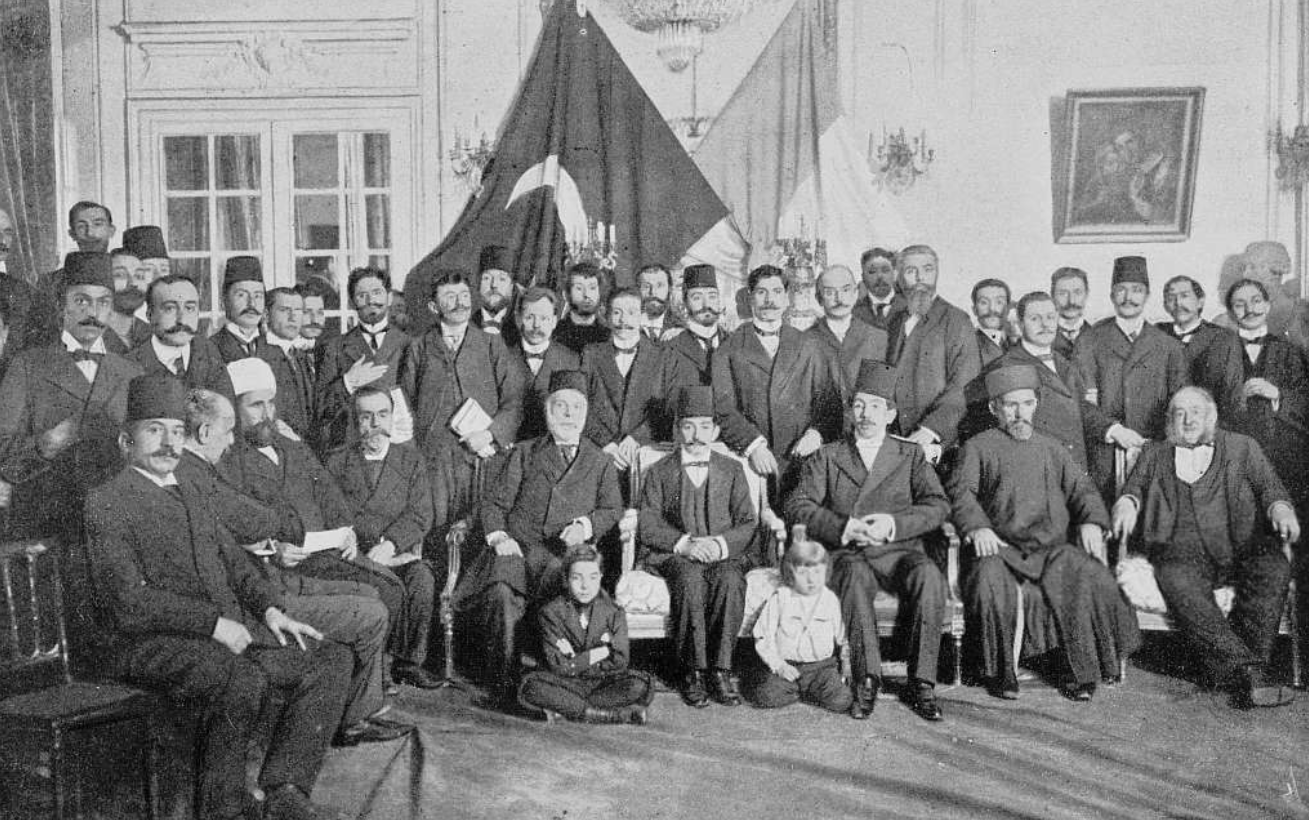
In 1908, the Committee of Union and Progress (CUP), a branch of the Young Turks organization, instigated an armed revolt against the Ottoman Sultan Abdulhamid ll, bringing about the revival of a constitution and a new parliament. A linear history of the later Ottoman period sees the reign of Sultan Abdulhamid as religious conservatism, the Young Turks as progressive secularization with the Kemalist republican age as one of laïcité. Such historicization omits the instrumental role of Islamic rhetoric for modernization initiatives during the constitutional period, leaving no room to examine the blurred lines between the religious and the secular.
Discussions of pan-Islamism in the 20th century tend to focus on German efforts to rally Muslims behind the Central Powers and against their respective colonial overlords, placing the Ottomans in a passive position within the alliance itself and omitting their religiosity. While the Turkish Empire was far from its apogee, the reductive yet common narrative of the declining “sick man of Europe” ignores the active role it played in the global political order. As the Ottoman Empire was the seat of the caliph, German Orientpolitik sought to align itself with it, given the attractive potential of the so-called “Muslim weapon.” In this view, the caliph’s call to arms could potentially rally the Muslim colonized populations against their imperial overlords—enemies of the Germans—thus fueling revolt in British India, French North Africa, and the Russian Caucasus.1 The German-Ottoman alliance is not only significant because of the Kaiser’s interpretation of pan-Islamism. In fact, the Ottomans actively sought out and benefitted from German economic and military infrastructure.2
Through the instrumentalization of pan-Islamism during the Italo-Turkish War (1911-1912), we can further complexify our understanding of the CUP, a government typically associated with secular nationalism. The Libyan War provides insight into the relatively successful anticolonial manifestation of CUP’s religious foreign policy.
Pan-Islamism and European Interpretations
The pan-Islamic sentiments of the late nineteenth and early twentieth centuries refer to the political unity of Muslims around the globe under the figure of the caliph.3 Muslim intellectuals such as Jamal al-Din al-Afghani turned to Muslim unity to counter European hegemony instead of falling into ethnic strife, advocating for stabilization through solidarity.
The term “pan-Islamism” itself has origins in Orientalist discourse as Europe espoused a pervasive fear of solidarity on the basis of Islam within the colonized world. Imperialists believed that Muslims presented a single united “nation” when, in reality, notions of a single supranational political unit grew as a reaction to European hegemony. New networks of transmission of information of the industrial revolution allowed for unprecedented levels of inter-communal communication where pan-Islamic solidarity bled through imperial borders.4 European understandings of pan-Islamism are dependent on a classification of Muslims as an inferior race with the potential of uniting to destabilize the imperial world Order, highlighting the supposed unique fanatic fervour of Islam.5
The Shifting Religious Discourse
During the constitutional post-revolutionary period, the Young Turks embarked on ambitious reforms to modernize the empire, notably in the fields of sciences, industry, and the military. To better sell the Western-style initiatives on the domestic front, the CUP stressed Islam as being both compatible with and integral to their project of synthesizing “East and West.” A nationalist Islam represented the social cohesion of the empire.6 For instance, the preservation of the office of the caliph served to preserve the support of more skeptical conservative Muslims within the CUP as well as of the Indian Muslim elite with whom the ancien regime had established a close relationship.7
The pan-Islamism of the Young Turks differs from both European conceptions and those of Sultan Abdulhamid. The application of pan-Islamism under the ancient regime served, to some extent, to overturn many initiatives of the Tanzimat reforms (1839-1876), namely regarding education and language.8 However, the pan-Islamic foreign policy of the Young Turks depended on Hamidian connections. While Abdulhamid ll definitely kept significant communications with Indian coreligionists, he did not outwardly oppose their British overlords. During the yearlong war of attrition in Libya, the Young Turks, having recruited a significant army of local insurgents and smuggled military officers, “marched into North Africa as champions of anticolonial Islam.”9 The principal differences between Hamidian and Unionist pan-Islamism lie in the latter’s embrace of anti-European colonialism and emphasis on compatibility with liberal institutions.
Islamic Humanitarianism and Volunteerism in Wartime Libya
Seeking to establish itself as a European imperial power with colonies in Africa, Italy tried to expand its influence over the last Ottoman-controlled territories in North Africa, Benghazi and Tripoli. By October 1, Italian troops had hit the Libyan coast and imposed a naval blockade on the Turkish Empire. At the start of the war, given the lack of a casus belli for invasion, the Ottomans believed appealing to international law would lead the great powers to advocate for them and come to their aid.10 The CUP initially believed diplomatic exchanges with European powers would engender an intervention on their behalf or a forceful Italian retreat. Despite the efforts of Ottoman press and ambassadorial private exchanges, their calls of injustice were met with indifference. Although public sympathies were slanted towards the Ottomans, the Germans were the only European power outwardly condemning the Italian ultimatum. The CUP shifted towards adopting pan-Islamism as the defensive ideological underpinning, as international liberalism failed to garner material support.11 The two main manifestations of CUP religious foreign policy lie in the successful Islamic based humanitarian and volunteer effort during the yearlong war.
Research into aid organizations in the Italo-Turkish War often highlight the efforts of the German Red Cross mission, omitting the leadership role played by the Ottoman Red Crescent as the main force behind acquiring and distributing foreign aid.12 Scholarship on early humanitarianism tends to focus on Christian missionaries, whose activities often rested on proselytizing, and ignores the internationalism of the Red Crescent Society.13 The Ottoman Red Crescent Society grew exponentially as a result of global sympathies due to the Italian blockade. The formerly weak organization during the Hamidian period, thanks to hefty donations, was able to provide medical care for both the Ottoman volunteer army and civilians.14 Donations were collected from prominent Muslim societies, and wealthy and working class individuals alike through the Ottoman Embassy in London.15 While the organization started with a budget of 15,000 lira, foreign donations amounted to around 1 million U.S dollars during the yearlong war, corresponding to 80% of the funds amassed.16
Pan-Islamism manifests itself through the volunteerism of Libyan insurgencies. Regarding the makeup of the Ottoman volunteer army, British war correspondent G. F. Abbott highlighted that the ethnic and linguistic diversity of the troops was unimportant in light of their unified allegiance to the sultan/caliph through whom they fought for the Prophet.17 While the Italians made their way to Tripoli with conscripts, the Ottomans fought with volunteers. The influential Sanusiyya leader Sayyid Ahmad al-Sanusi officially declared jihad on the Italian invaders.18 Local religious leaders were instrumental in recruiting volunteers, particularly through appealing to the cruelties of the invaders.19
The Ottomans recognized the asymmetrical war being waged upon them and the impossibility of reclaiming any Libyan territory under imperial auspices.20 Enver Pasha, minister of war, claimed to be guided by the Islamic duty expected of the caliphate to resist Italian incursions. Enver presents a particularly interesting case in discussing the blurred lines between secularism and pan-Islamism in the constitutional phase. He participates in Hamidian pan-Islamism where religion is instrumental to “preserve the cohesion of the empire,” and he was the face of Islamic recruitment for the Libyan volunteer army. However, the “Action Army,” under his command during the revolution, suppressed Islamic societies calling for the reinstution of shari’a.21 The support from the Sanusi Order was crucial and this alliance was solely secured through Enver’s personal connections to the royal family, thus appealing to their reverence for the caliph.22
Politics of Defeat
The fierce guerrilla response to the invasion and the difficulty in making any advances in Libya caught the Italians by surprise. Under pressure to save face, the Mediterranean kingdom resorted to diverting Ottoman forces as they bombed Beirut, occupied the Dodecanese, attacked the Dardanelles, and fueled the Balkan alliance-system into war with the Turkish Empire.23 The Balkan Wars interrupted the fight in Libya and a tentative peace deal was brought about, leaving the territory in control of the Italians with the local insurgency remaining active. While the last Ottoman possession in North Africa was officially lost, the strong guerrilla resistance and comparatively high financial burden of the Italian treasury proved the potential force of unity through Islam to the international community.24
With the exception of Gallipoli during the First World War, the Ottoman Empire faced a series of defeats, leading to the pressing matter of imperial survival itself. The emphasis of ethnoreligious politics based on faith within the multi-confessional empire, as witnessed during the Italo-Turkish War, was amplified. Many frustrated soldiers were radicalized, as the military apparatus sought to eliminate the enemy from within. In Anatolia, this radicalization led to the genocide of non-Muslim minorities notably the Armenians and Assyrians.25 In the end, the seat of the caliphate was abolished by the Republic of Turkey in 1924, eliminating the center of a pan-Islamic unity. Pan-Islamism in the pre-WWI constitutional period represented a means to stand against European imperialism, yet as the Ottoman imperial core weakened, the CUP’s nationalist view of Islam shifted towards radical violence.
FOOTNOTES
- Tilman Lüdke, “(Not) Using Political Islam: The German Empire and Its Failed Propaganda Campaign in the Near and Middle East, 1914–1918 and Beyond,” in Jihad and Islam in World War I: Studies on the Ottoman Jihad on the Centenary of Snouck Hurgronje’s “Holy War Made in Germany,” ed. Erik-Jan Zürcher (Leiden University Press, 2016), 72; 74; 78.
- Jonathan Claymore McColum, “The Anti-Colonial Empire: Ottoman Mobilization and Resistance in the Italo-Turkish War, 1911-1912,” (PhD diss., UCLA, 2018), 56-57, eScholarship.
- Lüdke, “(Not) Using Political Islam,” 77.
- Cemil Aydin, The Idea of a Muslim World: A Global Intellectual History, (Harvard University Press, 2017), 6-7.
- Lüdke, “(Not) Using Political Islam,” 77.
- Pinar Batur-Vander Lippe and John M. Vander Lippe, “Young Ottomans and Jadidists: Past Discourse and the Continuity of Debates in Turkey, the Caucasus and Central Asia,” in Turkish Studies Association Bulletin 18, no. 2 (1994): 67. http://www.jstor.org/stable/43384473; Ram Lakhan Shukla, “The Pan-Islamic Policy of the Young Turks and India,” in Proceedings of the Indian History Congress 32, (1970): 303; 306, http://www.jstor.org/stable/44138557.
- Shukla, “The Pan-Islamic Policy,” 305.
- Lippe, “Young Ottomans and Jadidists,” 74.
- McCollum, “The Anti-Colonial Empire,” 134.
- Mustafa Aksakal, “‘Holy War Made in Germany’? Ottoman Origins of the 1914 Jihad,” in War in History 18, no. 2 (2011): 194. https://doi.org/10.1177/0968344510393596.
- McCollum, “The Anti-Colonial Empire,” 12; 24-25.
- ibid., 60.
- ibid., 8.
- ibid., 87.
- 16. ibid., 92-93.
- ibid., 121.
- ibid., 166.
- ibid., 160.
- 21. ibid., 121-122.
- ibid., 132.
- Eugene Rogan, The Fall of the Ottomans: The Great War in the Middle East, (Basic Books, 2015), 17-18.
- Rogan, The Fall, 17-18.
- Lüdke, “(Not) Using Political Islam,” 90.
BIBLIOGRAPHY
Aksakal, Mustafa. “‘Holy War Made in Germany’? Ottoman Origins of the 1914 Jihad.” War in History 18, no. 2 (April 1, 2011): 184–99. https://doi.org/10.1177/0968344510393596. Aydin, Cemil. The Idea of the Muslim World: A Global Intellectual History. Harvard University Press, 2017. https://doi.org/10.4159/9780674977402
McCollum, Jonathan Claymore. “The Anti-Colonial Empire: Ottoman Mobilization and Resistance in the Italo-Turkish War, 1911-1912.” PhD diss., University of California, Los Angeles, 2018. eScholarship. https://escholarship.org/uc/item/5341c962
Lippe, Pinar Batur-Vander, and John M. Vander Lippe. “Young Ottomans and Jadidists: Past Discourse and the Continuity of Debates in Turkey, the Caucasus and Central Asia.” Turkish Studies Association Bulletin 18, no. 2 (1994): 59–81. http://www.jstor.org/stable/43384473.
Lüdke, Tilman. “(Not) Using Political Islam: The German Empire and Its Failed Propaganda Campaign in the Near and Middle East, 1914–1918 and Beyond.” In Jihad and Islam in World War I: Studies on the Ottoman Jihad on the Centenary of Snouck Hurgronje’s “Holy War Made in Germany,” edited by Erik-Jan Zürcher. Leiden University Press, 2016. http://www.jstor.org/stable/jj.1011741.8.
Rogan, Eugene. The Fall of the Ottomans: The Great War in the Middle East. New York, Basic Books. 2015.
Shukla, Ram Lakhan. “The Pan-Islamic Policy of the Young Turks and India.” in Proceedings of the Indian History Congress 32, 302–7, 1970. http://www.jstor.org/stable/44138557.