
A failed state is not defined by a single collapse, but by the slow erosion of its core functions; the ability to govern, to protect, and to inspire trust in its people. Lebanon, once renowned as the “Switzerland of the Levant,” has in recent decades become a striking example of this erosion. Decades of systemic corruption have hollowed out state institutions and left the country unable to effectively exercise authority or safeguard its sovereignty.
As such, Lebanon ranked 149th out of 180 countries in Transparency International’s 2020 Corruption Perceptions Index, underscoring the depth of its governance crisis. Entrenched political nepotism and elite capture have not only paralyzed state institutions but also eroded public confidence. Foreign influence further destabilized an already fragile system, fueling socioeconomic inequalities and deepening public resentment.
In the decades after the 1975–1990 Civil War, Lebanon’s state capacity eroded under entrenched corruption, political nepotism, and elite capture. Only 9% of Lebanese adults express confidence in their national government;[1] This erosion of public trust, compounded by escalating foreign interference, has further weakened Lebanon’s fragile political system and sovereignty. These converging pressures set the stage for the 2019 crisis. Tracing the road to 2019, this paper demonstrates how weak institutions, corrupt patronage, and governance failure converted growth into scarcity, widened inequality, and ultimately culminated in a full-blown banking crisis.
I. Historical and Social Context: Foundations of Post-War Corruption and Financial Collapse
The aftermath of the Lebanese Civil War was catalyzed within the Taif Agreement of 1989. This so-called agreement surrendered all core state activities to Syria and Saudi Arabia, its main mediators, and institutionalized a system of government that ultimately enabled deep-rooted corruption. While the treaty enshrined sectarian power-sharing, it was also designed with an amnesty clause that pardoned warlords and corrupt politicians, permitting them to gain control of ministries, public institutions and reconstruction funds. As such, it became very easy for these figures to funnel state resources into private networks. Very shortly after, in 1992, Lebanon embarked on a reconstruction process heavily anchored in its service sector, mainly banking and real estate. Spearheading this project was the late Prime Minister Rafik Hariri, whose vision of rebuilding the country emphasized financial liberalization, luxury urban planning, and attracting foreign investment, particularly from Gulf states and the Lebanese diaspora. This was mainly aimed to turn Lebanon into a regional hub: a “Hong Kong or a Riviera”.[2]
Thus, Solidere, a private real estate company, was established by Hariri in 1991 through controversial Law 117 that established the framework for reconstruction. According to French researcher Fabrice Balanche, the creation of this company and the passing of this law required a huge amount of public bribery that could only have passed if it targeted all the public leaders of the country.[3] Solidere, privatized in 1994 and listed on the Beirut Stock Exchange, received extensive legal and political authority, allowing it to expropriate large sections of downtown Beirut, leading to forced evictions. Hariri, Solidere’s largest shareholder, blurred the line between public policy and private gain, exemplifying postwar corruption linked to Lebanon’s political elite. Solidere epitomized a redevelopment model marked by elite capture, regulatory weakness, systemic corruption, and opaque public procurement practices. This reconstruction model was part of a broader system of rent-seeking mechanisms involving compensation, Treasury Bills, and high interest rates.
By the end of the 1990s, Lebanon’s sovereign debt ranked among the highest in the world, much of it held by Lebanese banks either directly owned or affiliated with Hariri.[4] The Central Bank of Lebanon (BDL), under the leadership of former Merrill Lynch banker Riad Salameh, implemented financial engineering schemes that offered banks exorbitant returns for attracting foreign currency deposits. Operations were conducted to bolster foreign-currency reserves and defend the pound’s peg by paying banks exceptionally high returns for sourcing and placing fresh USD at the central bank. In the 2016 scheme, BDL swapped LBP T-bills for Eurobonds and then sold their USD assets to banks, while letting them borrow LBP at 2% interest and re-deposit at 10.5%, creating a risk-free carry. The package also domestically financed fiscal deficits via bank purchases of sovereign paper, and boosted gross reserves even as net reserves deteriorated, while widening maturity and currency mismatches, thus creating a false image of good LBP valuation. Short term, this steadied the peg; longer term, it concentrated bank exposure to the sovereign/BDL and made the system dependent on continuous new inflows, magnifying the eventual break.[5]
This fed into an unsustainable financial structure that depended on continuous capital inflows, primarily from Lebanese expatriates across Europe, Africa, South America, and the Middle East. As time went on, risks related to the system changed from mainly devaluation risks reflected in risk premium on LBP deposits over USD deposits, and default risks started to rise showing as risk premia on dollar deposits over global dollar rates (Appendix 1). Over time, banks used these inflows to lend to the state and reap extraordinary profits, creating a debt-to-GDP ratio of more than 150%.[6] With the same elite controlling the state, financial institutions, and major sectors of the economy, meaningful reform remained elusive despite pressure from international institutions like the IMF in its publications and the World Bank.[7]
The last step in understanding how the banking crisis unraveled is to look at capital flows and their accumulation. Over two decades, these capital flows kept financing and expensing an imbalance between public and private savings; they can be divided into a public and a private component according to the national account identity formula.[8] Capital flows and their subsequent effects on the economy can be broken down into the following formula:
Current account deficit = Private (savings – investment) + Government deficit
It is important to note when looking at the evolution of the current account and the public deficit over time, (Appendix 3), how capital flows started financing mainly a private sector deficit rather than a public one. The private deficit expanded: households, firms, and banks were spending more foreign currency than they earned, producing sustained outflows. This rise was driven by capital flight, with political elites, who had prior knowledge of an imminent crisis, transferring substantial funds overseas. This dynamic is exemplified in the pre-crisis year, when the private deficit peaked around 22% of GDP. Furthermore, the artificial currency peg made foreign goods artificially cheap which in turns encouraged massive imports of goods. This consumption was made possible and facilitated by large monopolies that held exclusive import licenses, obtained through bribes, indicating how corruption funnelled through what was supposed to be private economic activity, revealing the complicity of the government.
By 2019, remittances and capital inflows began to slow and the system put in place by the wealthy elites could no longer sustain itself. Additionally, some Lebanese banks were sanctioned by the US Department of the Treasury for allegedly facilitating money laundering and for their ties to the corrupt system. Jammal Trust Bank was one of those sanctioned, eventually having to self-liquidate as a result.[9] This incident sent shockwaves through the broader Lebanese banking industry. As foreign governments continued to intervene, internal confidence within the system continued to decay, leading to even bigger capital flows, while capital controls, withdrawal limitations, and concern about the financial system’s viability have all contributed to a loss of trust in banks. A notable example is that of the US, who seemingly took it upon themselves to sanction any institution and politician that did not stand with or align themselves with American interests.[10]
II. The Crisis and Its Dire Economic and Humanitarian Effects
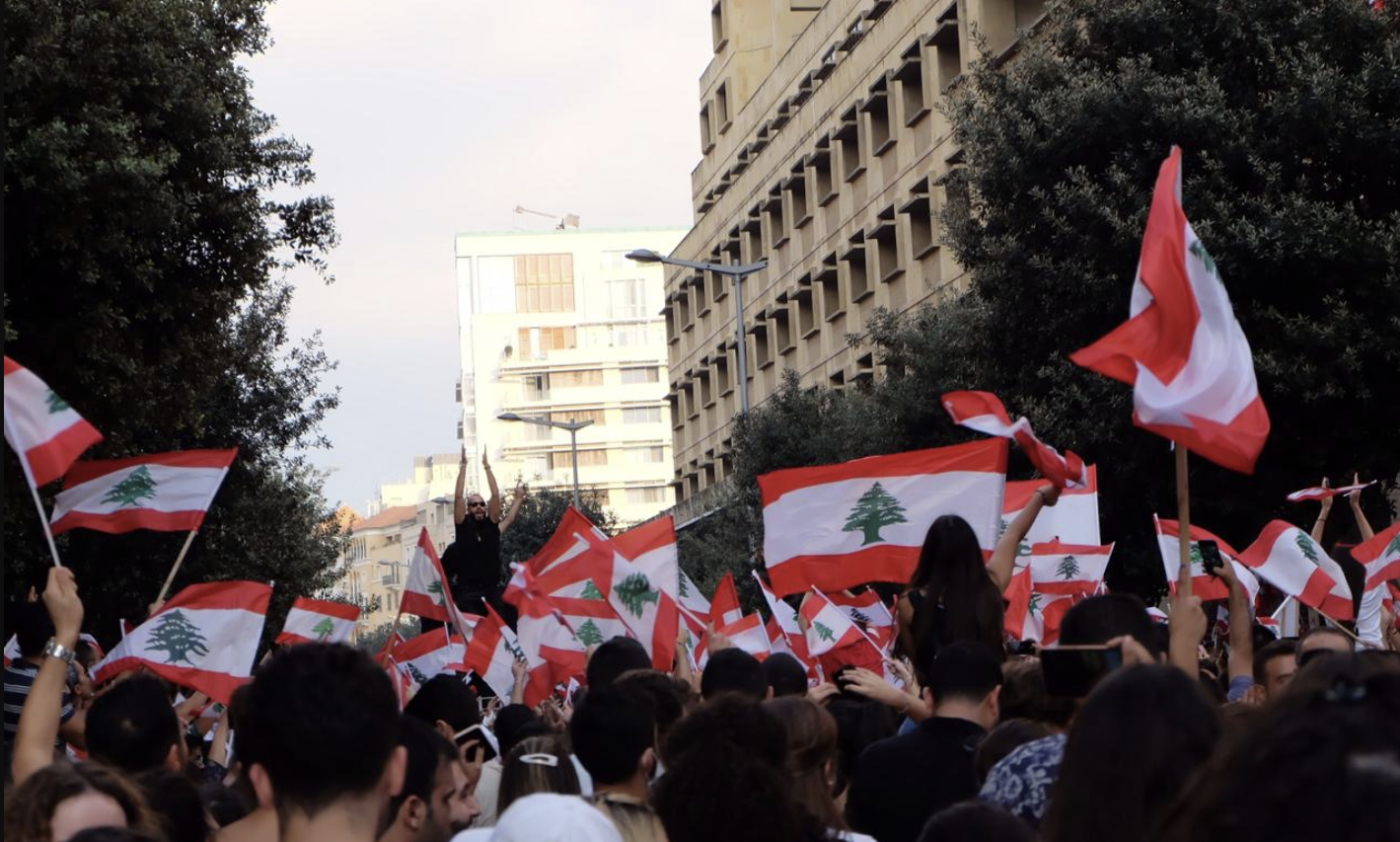
Large protests erupted in October 2019, reflecting deep frustration with the state, systematic corruption, and financial stagnation. Throughout this entire turmoil, banks began facing large liquidity shortages as depositors rushed to withdraw their funds; the general response was to implement formal capital controls and block transfers abroad. This measure was completely unprecedented and was neither backed by legal reasons nor voted upon, creating an even greater uprising as the wealthy elites were still able to wire their funds abroad while the lower classes were left wondering what would happen to their funds. A striking example is that of Nady Salame, the son of Lebanon’s central bank governor, who was able to transfer over $6.5 million abroad and conduct property and real estate transactions exceeding $20 million, while most Lebanese residents saw their savings frozen.[11]
The collapse of the Lebanese pound (LBP) has unfolded with devastating consequences over the past several years, marking one of the most severe economic crises in modern history. Prior to the nationwide uprisings of October 2019, the official exchange rate was fixed at 1,507 LBP per US dollar. By early 2022, the LBP had plunged on the parallel, or “black,” market to over 30,000 per US dollar. The rate continued to deteriorate, reaching nearly 100,000 per US dollar by late March 2023, reflecting a total loss of confidence in both the domestic currency and the state institutions that underpin it.[12]
As reflected in the table in Appendix 2, the implications of the currency collapse are dramatic. By the end of 2022, Consumer Price Index change was multiplied by a coefficient of 10.4x as consumer goods were rising at an annual rate of roughly 200% between that time. Consequently, a large majority of the population could not even afford basic food services, exacerbating the gap between the poor and elite.
Parallel to the currency crisis, Lebanon’s economy has shrunk dramatically. Gross Domestic Product (GDP) plummeted from approximately $55 billion in 2018 to around $35 billion by 2020. By 2021, the economy had contracted further to an estimated $22–24 billion. Early indicators in 2022 suggested that this decline was ongoing, pushing Lebanon further down the global economic ladder. The effects of this contraction have been felt at the individual level. GDP per capita, which stood at roughly $8,000 in 2018, dropped below $3,000 by the end of 2021.This economic freefall has led to the near-complete annihilation of Lebanon’s once-thriving middle class. The poverty rate, which hovered around 30–35% in 2019, surged to 85–90% by late 2021[13] plunging the country into mass impoverishment and social despair, as families find themselves unable to afford even the most basic necessities of life. In sum, the currency collapse, output contraction, and explosion in poverty reflect a systemic breakdown that has turned a middle income economy into a humanitarian emergency; without credible stabilization, governance reform and targeted social protection, living standards will continue to erode and recovery will always remain remote and partial.
III. The Collapse of Governance and the Urgency of Reform
To conclude, as seen throughout this paper, corruption and agency-related issues can only deepen inequalities and drive a country toward systemic collapse. In the case of Lebanon, the entrenchment of elite interests, the manipulation of state resources for private gain, and the absence of accountability mechanisms dismantled public institutions from within. The 2019 banking crisis was not a sudden shock, but rather the inevitable outcome of decades of unchecked corruption, financial mismanagement, and political impunity supported by foreign agents. As state structures crumbled and public trust eroded, Lebanon’s governance capacity failed to meet even the most basic needs of its citizens, ultimately fulfilling the criteria of a failed state.
Lebanon now stands on a knife’s edge. Regional geopolitics have further eroded macro-financial stability and hard-currency inflows: Iran’s sponsorship of Hezbollah prompted Gulf withdrawals and investment pullbacks, while U.S. sanctions raised banks’ funding costs, restricted correspondent-banking access, and choked dollar liquidity. On the security front, recurrent Israel–Hezbollah hostilities over time have deterred foreign direct investment and tourism, and accelerated dollarization and capital flight. Together, these external pressures entrenched dependence on volatile inflows and hastened systemic breakdown. Against this backdrop, the very recent aggression and the forced displacement of over one million Lebanese further aggravate the crisis. Given the deepening humanitarian emergency, it is more urgent than ever for the newly appointed Lebanese government to make reforms and retake its sovereignty.
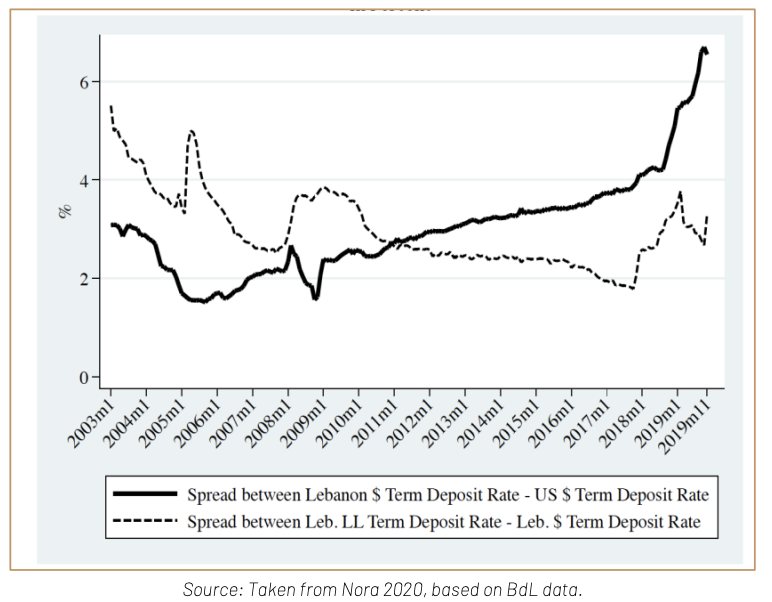
Appendix 1: Differences in spread and premium on LBP deposits and USD deposits over time.
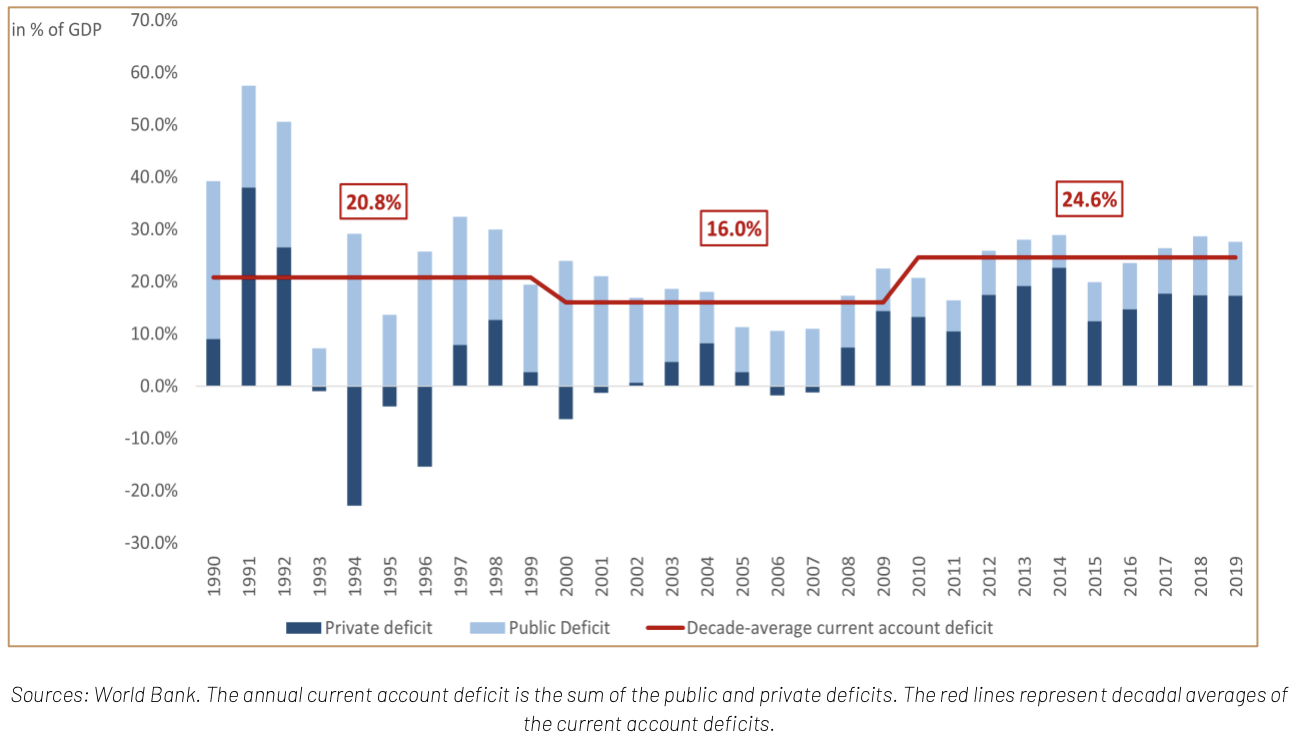
Appendix 2: Fluctuation of Current Account deficits over time, broken down between private and public deficits.
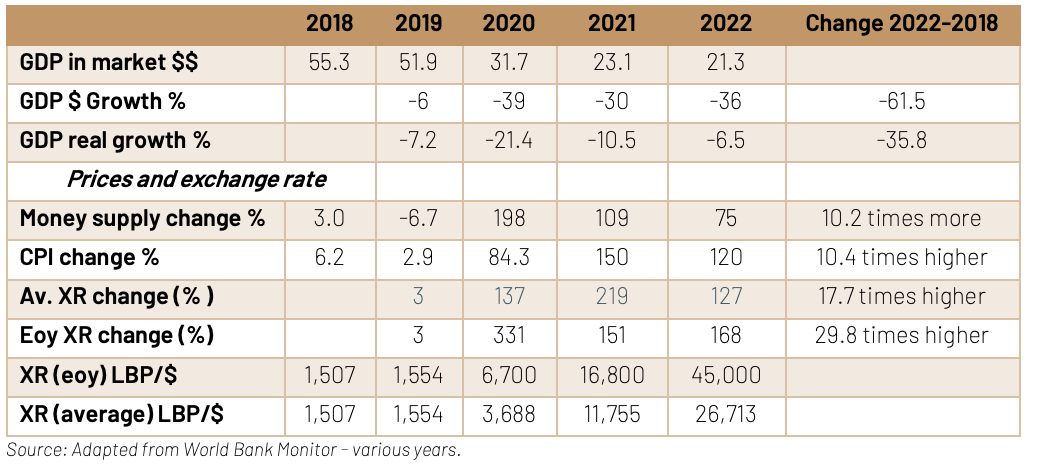
Appendix 3: Effect of the economic crash on key indices.
BIBLIOGRAPHY
[3] Balanche, Fabrice. “The Reconstruction of Lebanon or the Racketeering Rule.” Lebanon after the Cedar Revolution, 2012.
[10] Barakat, Majdy, and Sumru Altug. Research Report. An Economic Policy Uncertainty Index for Lebanon, 2023.
[8] Diwan, Ishac, and Henri Chaoul. Lebanon At Risk: The Uncertain Road from a Debt Overhang to a New Growth Path, Policy Note 9, July 2023.
[7] International Monetary Fund. Middle East and Central Asia Dept. “Lebanon: 2019 Article IV Consultation-Press Release; Staff Report; Informational Annex; and Statement by the Executive Director for Lebanon”, IMF Staff Country Reports 2019, https://doi.org/10.5089/9781513517049.002.
[2] Kaufman, Asher. “Lebanon’s Tragic Path from Economic Miracle to Collapse.” Kellogg Institute For International Studies.. https://kellogg.nd.edu/news/lebanon%E2%80%99s-tragic-path-economic-miracle-collapse.
[11] Kobaissi, Riad, Tom Stocks, and Rana Sabbagh. “Lebanon Central Bank Governor’s Son Moved Millions Abroad While Lebanese Watched Blocked Savings Dwindle.” OCCRP, May 13, 2022. https://www.occrp.org/en/investigation/lebanon-central-bank-governors-son-moved-millions-abroad-while-lebanese-watched-blocked-savings-dwindle.
[5] Oguri, Junko. “Part II of Crisis in Lebanon: Buildup of Interrelated Challenges ” Yale School of Management, September 21, 2020. https://som.yale.edu/blog/part-ii-of-crisis-in-lebanon-buildup-of-interrelated-challenges.
[4] Sharp, Deen. “Lebanon and the Fog of Reconstruction.” Project on Middle East Political Science (POMEPS) , 2018.
[6] Shawish, Hesham. “How Did Lebanon Become the Third Most Indebted Nation?” BBC News, October 25, 2019. https://www.bbc.com/news/world-middle-east-50183895.
[12], [13] Snaije, Bassem. “Lebanon: Financial Crisis or National Collapse?” CIDOB Notes Internacionales, no. 275 (June 2022). https://doi.org/10.24241/notesint.2022/275/en.
[9] “Treasury Labels Bank Providing Financial Services to Hizballah as Specially Designated Global Terrorist.” U.S. Department of the Treasury, August 29, 2019. U.S. . https://home.treasury.gov/news/press-releases/sm760.
[1] Vigers, Benedict, and Mohamed Younis. “Lebanon Ill-Equipped for Further Instability.” Gallup.com, January 2024. https://news.gallup.com/poll/548348/lebanon-ill-equipped-further-instability.aspx.
FURTHER READINGS
Blair, Edmund. “Explainer: Lebanon’s Financial Crisis and How It Happened | Reuters.” Reuters, January 23, 2023. https://www.reuters.com/markets/rates-bonds/lebanons-financial-crisis-how-it-happened-2022-01-23/.
Karam, Karam. “The Taif Agreement: New order, old framework.” Accord 24 (2012): 36-42. https://www.c-r.org/accord/lebanon/taif-agreement.
Mahmalat, Mounir. “The Grand Waiting Game: Why Lebanon’s Elites Postpone Compromise.” Economic Research Forum (ERF), February 14, 2023. https://theforum.erf.org.eg/2023/02/14/the-grand-waiting-game-why-lebanons-elites-postpone-compromise/.