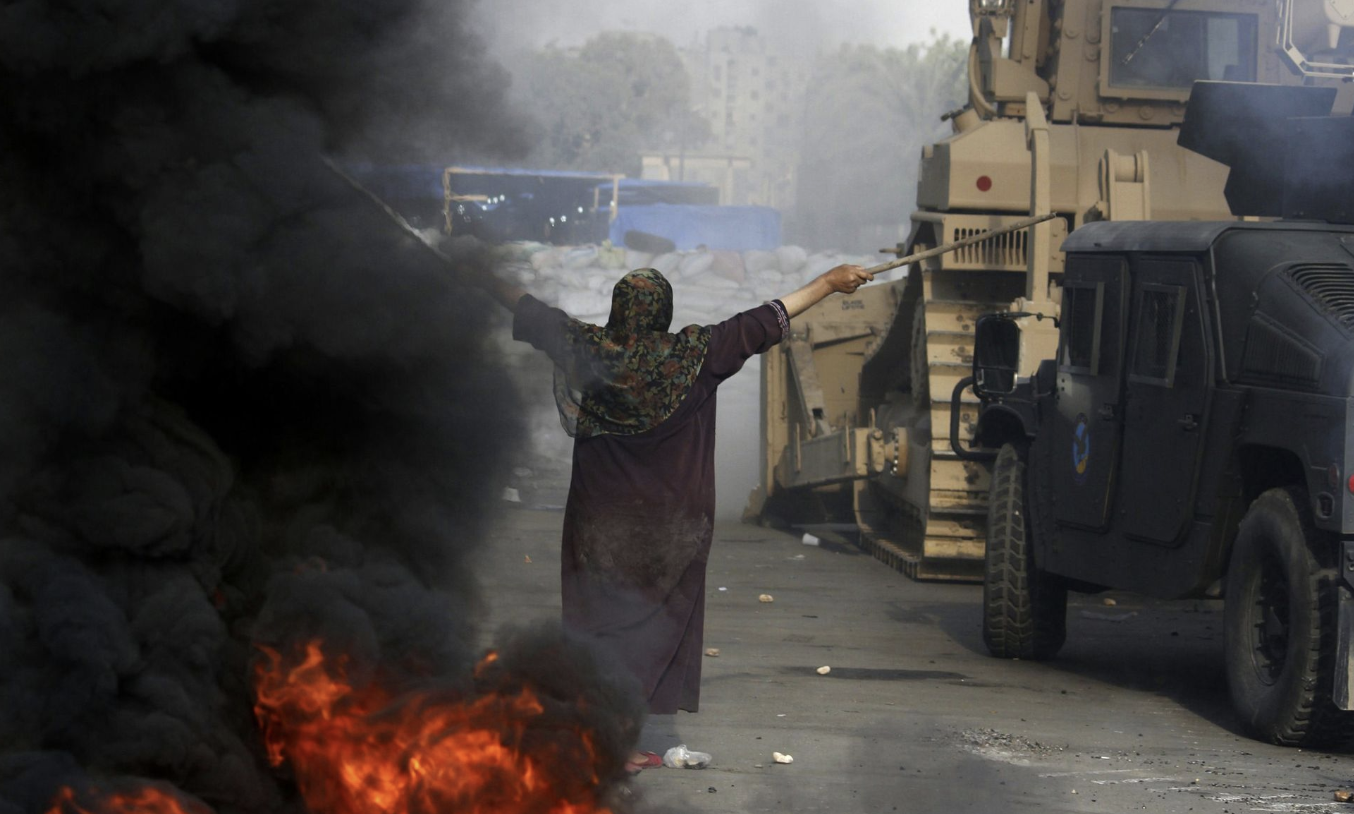
On 14 August 2013, Egyptian police and the armed forces under then–Defense Minister Abdel Fattah el-Sisi used lethal force to clear two protest camps in Cairo. For six weeks, Rabaa al-Adawiya and al-Nahda Squares had been occupied by supporters of President Mohamed Morsi, removed by a military coup one month earlier after mass protests against his rule. Attempts to end the sit-ins peacefully had failed. Within hours, both camps were cleared through mass killing of those who stayed.
Twelve years ago, the Rabia massacre took place in Egypt. We remember it not for its politics, but because it marked a national trauma: a clear line crossed in the human right to free expression. The collapse of the state’s tolerance for dissent was broadcast across the nation, which arguably set the tone for how any opposition would be treated during the early years of Sisi’s rule, and some framed it as a heroic act.
Beyond the structural imprisonment of dissenters across Egypt’s political spectrum, often without due process or humane conditions which are less visible, the Rabia massacre may mark a precedent of generalized deterrence: if it can happen to some, it can happen to anyone.
One can interpret the broadcasting of the bloodshed as orchestrated national trauma, comparable to the Wall in The Handmaid’s Tale, and as a calculated display of deterrence. Whether it was calculated or not, visible punishment reduces the likelihood of future opposition in Egypt.
One can view the massacre as a precedent-setting event. Once extraordinary repression becomes normal, it can be applied to any group. The boundaries between struggles dissolve, and the result is that across Egypt’s political spectrum, silence has become the safest political strategy.
We remember the Rabia massacre not for its politics, but because we cannot allow it to set a precedent for limiting expression. Whether pro-Sisi, pro-Ikhwan, or holding any other position on the Egyptian political spectrum, the mass killing of people should never be accepted, let alone celebrated.
From a realist perspective, the Rabia massacre was not only about the political moment but about creating an enduring deterrent. The deterrent appears to have succeeded: the political sphere in Egypt remains shaped by calculated silence, where speech carries not only cost but final cost.
BIBLIOGRAPHY
“‘Turning Point’: What Happened during Egypt’s Rabaa Massacre 10 Years Ago?” 2023. Al Jazeera. August 14, 2023. https://www.aljazeera.com/news/2023/8/14/turning-point-what-happened-during-egypts-rabaa-massacre-10-years-ago.
Michaelson, Ruth . 2020. “Threat of Jail Looms over Even Mildest Critics under Egyptian Crackdown.” The Guardian. January 24, 2020. https://www.theguardian.com/world/2020/jan/24/threat-of-jail-shapes-egyptian-lives-nine-years-after-uprising.
Nouran El-Behairy. 2013. “Dailynewsegypt.” Daily News Egypt – Egypt’s Only Daily Independent Newspaper in English. June 28, 2013. https://www.dailynewsegypt.com/2013/06/28/islamist-forces-join-together-for-rabaa-al-adaweya-protest/.