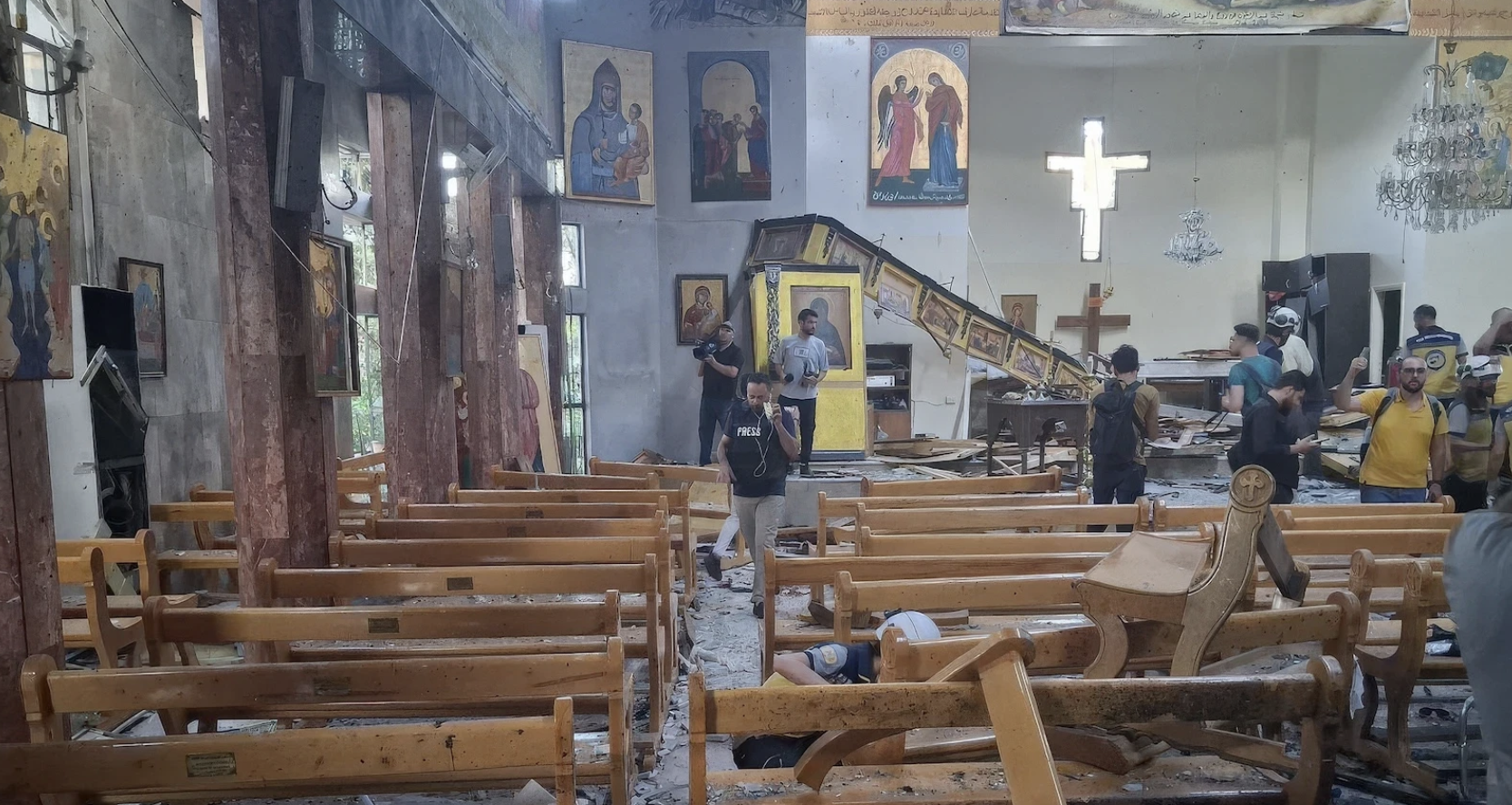
On June 22, a suicide bomber walked into the Mar Elias Orthodox church, in Dweilaa, Syria, and detonated a bomb. The attack killed over 20 people and injured tens more. This tragic event marks a setback in Syria’s path to overcoming sectarian divisions amidst widespread poverty and vulnerable state-building following decades of authoritarian political monopoly.
The fringe hardline Islamist group, Saraya Ansar al-Sunna, claimed credit for the attack while the Syrian Ministry attributes it to the Islamic State. Many sources claim the attacker was not Syrian. Islamist groups and similar perpetrators of such attacks are easily categorized as vague Muslim entities that solely or majorly target Christian communities. However, this categorization ignores the slaughter of thousands of other Muslim minorities caused by terrorism which emerged within the inherent instability of transitional governments, following years of structural oppression of the Assad regime. The Greek Orthodox’s Patriarch Yaziji of the East wrote to Ahmad al Sharaa, saying “the people are hungry. If no one else is telling you this, I am. People come to our churches asking for money to buy bread,” emphasizing the glaring central issue of poverty that continues to ravage Syrian lives, indiscriminate of sects.
We were put in contact with Kristena, a member of the Syrian Christian community in Damascus, through a fellow member of the MPRA. We wanted to evade the obscurities and general dogmas of mainstream reporting on Syria to gain a close-up and intimate perspective of the church massacre that had so recently wounded the nation and people of Mar Elias.
Before we began the interview, Kristena gave us some background on her perspective and relationship with Syria in the last decade. She felt Syria was relatively safe before the beginning of the Assad regime’s war on its people in 2011. She left the country in 2011, and her last visit was in 2013. Kristena’s outlook is that Syria would never be the same, nor better than it was before. She felt her memories were gone with the places that were destroyed, and the people either escaped or became casualties of the war.
Q: Are you personally aware of anyone affected in the attack?
A: Yes, one of the martyrs was a man we knew very well. He was our neighbour and very close friends with my uncle.
When everyone was in church, the attacker entered and began shooting. Two men, Milad Haddad and Geryes Bechara blocked the attacker and pushed outside the church before his suicide bombs exploded.
We consider those two men heroes because they sacrificed their lives for the rest of the people there. Without them the attack would have been much more devastating. Hopefully they become recognized as saints.
Mar Elias is the Orthodox Church, and my aunt and cousins were close by in the Catholic Church when the attack happened. They called us and sent some videos— they were in shock at the sight of people dead on the floor. Thankfully, my family wasn’t affected but many others suffered greatly.
Q: What is the overall sentiment within the Damascene Christian community in the aftermath of the attack?
A: There was a lot of grief, fear, and deep concern, but also resilience. I thought people would hide in fear, but they went outside and chanted prayers together, it was beautiful to see. It was nice to see people reunite again, despite the deep concern that an attack like that could happen again.
People chanted for security and showed they were unafraid. They mourned the loss of the dead and the ongoing instability in the region. There was a sentiment before the attack that the region was protected, because nothing like it had ever happened in the community.
Note: For over five decades under Assad rule, while sectarian violence was present in various forms across the country, churches in the capital remained relatively safe, making the Mar Elias bombing historically unprecedented in the community’s living memory given the intensity of the attack.
Q : The current Greek Orthodox Patriarch of Antioch, Fr. Yaziji, wrote in his letter to Syrian President Ahmad al Sharaa that “the people are hungry. If no one else is telling you this, I am. People come to our churches asking for money to buy bread.” Do you feel this is reflected in the Syrian quality of life at the moment?
A : This statement definitely reflects a real and painful truth about the current quality of life in Syria for everyone. The general economic situation has deteriorated, unemployment is widespread and basic necessities such as medicine, bread and fuel for the winter have become increasingly expensive and difficult to procure.
This has made numerous families and households lose hope as they had expected the new government to intervene and assist them as well as to make them feel a sense of security.
The fact is that not only Christians go to churches asking for bread and money, but so do Syrians from all cultures and sects.
Q : How has the Damascene Syrian Christian perspective towards the country evolved in the last decade?
A : It has been shaped by conflict and the evolution of life under numerous political systems, but with the decline of conflict in Damascus over the past few months, many communities were focused on building back their lives and maintaining their culture and religious identities for this could all in all foster a sense of belonging to a country, to a changed Syria.
There is a growing sense of resilience, but it is tempered by a loss of hope, as Syrian minorities continue to live without the safety and security a government should provide; conditions that have not been adequately met for years and remain unfulfilled amid this ongoing transitional period. They had hoped for change and greater state representation, but due to multiple incidents of aggression since December 8th, 2024, they currently feel excluded from the Syria they envision, experiencing a level of representation not too different from that under Assad’s rule.
Even though they are minorities, they are what makes Syria, well, Syria !
They are now feeling like they’re being treated as a negligible percentage of the Syrian population, contrary to the relative stability they once experienced—though that stability came under a regime that was far from equitable or free. They had expected better, but are met with uncertainty and fear for now, so long as the transitional instability persists.
As we followed up on the questions we had prepared for her, we wanted to ask Kristena about her overall feelings after the fall of the Assad regime on December 8th, 2024:
We felt fear as a minority for how it would be represented, and we didn’t know what to expect for the future. I had sort of expected a tragedy such as the church bombing to happen eventually.
Any hope has been difficult to sustain given that the new government emerged from a long period of instability. While the political landscape remains in transition, many feel that promised reforms and broader representation have yet to take shape.
Kristena followed up by expressing her disappointment in the American media landscape for not even covering the news of what had been happening since the new administration took over, as well as their general indifference.
I remember my grandmother once telling me “كان في حضارة” (“there had been a civilization”) when talking about Syria’s cultural richness and millennial history, which might be compromised in the public eye because of a total absence of institutions to stand on, all of which has left behind a people who has become forced to solely focus on self-preservation and survival to the detriment of the country general development, which has become a secondary objective for many.
This isn’t the first time such atrocities have occurred in our history, but the overall lack of backlash has strengthened my lack of optimism for the future.
However, I feel lucky to be living in a country, [Canada], where I can freely practice my religion without any fear.
As the interview went on, we were expressing our grievances on the lack of overall media available to the public which would expose these critical issues to a much larger scale, leaving many pessimistic about significant socio-cultural change in the whole region.
Further Thoughts: A Generational Lesson in Memory and Reconciliation:
After the bleak oversight on Syria this discussion had left on us all, all of us convened to take heed of a tragic lesson from the not-so-distant past: the instance of the postwar memory amongst generations of Lebanese people who were born and have grown up following the bloody Civil War spanning from 1975 to 1990, encompassing many of the socioeconomic, political and sectarian tensions amongst the significantly diverse Lebanese people:
Most of today’s Lebanese youth has had to face at least one of two patterns of behavior from their parents’ generation: either attempts to totally conceal the war’s atrocities and bloodbath, which would have them inherit ignorance that would turn into apathy and disinterest over their formative years, or partial retellings of a specific perspective on how the war was fought, which could have some individuals embrace wartime ideologies and characters without having grasped the full picture.
What worsens the situation is the lack of public education and multilaterally agreed upon narratives about the Civil War due to political disagreements and a near-total absence of official reconciliation between different Lebanese sects.
This could soon apply to a Syrian people whose unity and coherence is being tested by the grief and devastation that follows 13 years of brutal repression following the Syrian uprising. It is a matter of urgency to preserve a collectively agreed upon memory of the tragic past decade which, if left unchecked, could provoke the irreversible deterioration of Syrian society in the very near future.
BIBLIOGRAPHY
Monde, Le. “Syria: Little-Known Jihadist Group Claims Damascus Church Attack.”
Le Monde.fr, Le Monde, 24 June 2025, www.lemonde.fr/en/international/article/2025/06/24/syria-little-known-jihadist-group-claims-damascus-church-attack_6742680_4.html.